Showing posts with label Mike Havenaar. Show all posts

Tuesday, September 18, 2012

Japanese Players In Europe

Hiroshi Kiyotake celebrates scoring the winner against Borussia Monchengladbach

Japanese players had a great weekend in Europe, especially in Germany where three players scored their first Bundesliga goals.
FC Nurnberg’s 3-2 away win at Borussia Monchengladbach might end up being remembered by viewers as the game in which Hiroshi Kiyotake showed Germany exactly how good he is. Kiyotake put in a masterful performance against last year’s fourth place team, setting up two and scoring the winner (his first Bundesliga goal). In the 17thminute, he delivered an excellent freekick from the left that was headed in by Timm Klose. Then in the 25th minute, it was a corner kick that was headed in by Timmy Simons for a 2-0 lead. Monchengladbach fought back to equalize, led on by the impressive Patrick Herrmann. But Kiyotake ensured that Nurnberg got all three points and continued their excellent start to the season, scoring the winner in the 55th after a determined run and an outstanding right-foot finish from outside the box. The goal came just two minutes after Granit Xhaka had equalized for Monchengladbach.
In addition to the assists and goal, Kiyotake was outstanding throughout, playing small passes and leading the counterattack as Monchengladbach controlled possession. He was constantly on the move, always providing an option for teammates to pass to. The Monchengladbach defenders found him hard to defend, as he kept the ball with his control and agility. Nurnberg fans are surely excited about their new number 13 and what the team can achieve this season. They are in 6th place and undefeated through three rounds.
Eintracht Frankfurt are off to an even better start, perfect through their first three matches. They beat Hamburg 3-2 at home this weekend, and Takashi Inui opened the scoring in the 13th minute with his first Bundesliga goal. After getting the ball from a defensive mix-up, Inui glided through two defenders with a quick feint and curled in past Rene Adler. The goal looked like one that Luka Modric would score, a player that Inui is similar in style to. Like Kiyotake, Inui played well throughout. He was substituted in the 79th minute. Frankfurt are in second place on goal difference, behind Bayern. On the other hand, Hamburg look like they are in real trouble this season and could end up being relegated, something they narrowly avoided last season.
One place below Hamburg, in last on goal difference, is Hoffenheim. This weekend they lost 5-3 away at SC Freiburg in an entertaining match. Takashi Usami was given a starting place and scored a fantastic goal, his first in the Bundesliga. After taking the lead in the 2nd minute, they were behind 2-1 by the 27th. They equalized in the 57thbut were pegged back again in the 68th. Usami equalized in the 76th minute with an unstoppable shot, but Freiburg scored twice in the final ten minutes to send Hoffenheim to their fourth straight loss in all competitions. Max Kruse was the standout player for Freiburg. In his first start of the season, Usami played well in addition to scoring his outstanding goal in what was a difficult match. It was an encouraging performance from Hoffenhim, though that won’t ease the pressure on manager Markus Babbel. They will try to get their first points at home against Hannover this weekend.
Keisuke Honda scored both goals in a 2-0 home win over FC Alaniya. For the first, he passed to Ahmed Musa who drew four defenders before passing back to Honda on the edge of the box. Wide open, Honda rifled into goal. For the second, Musa again found Honda, this time with a left side cross which Honda put in first time.
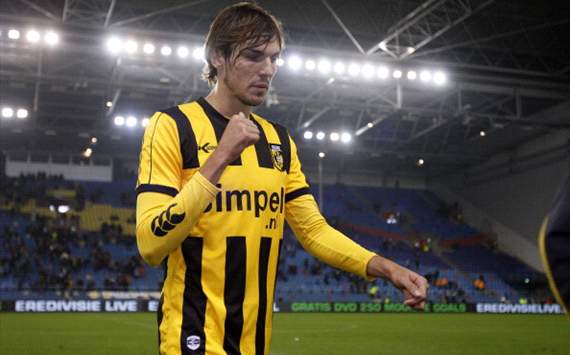
Mike Havenaar scored and set up another, leading Vitesse to a 3-0 win over Groningen. The goal was his first of the season. After struggling in the first half, Vitesse threw on Mike to energize the attack. The move paid huge dividends, with Mike opening the scoring in the 62nd before setting up Tomas Kalas for the second. He headed in a Patrick van Aanholt cross for his goal and led a two on one break before passing to Kalas to set up the second. His presence gave the Vitesse forward line a focal point through which to attack. It was Vitesse’s fifth straight win in all competitions and they remain unbeaten in the Eredivisie. They are in second on 13th points, behind Twente who remain perfect.
Stuttgart played out a goalless at home to Fortuna Dusseldorf. Shinji Okazaki came off the bench for Tamas Hajnal in the 86thGotoku Sakai was not included in the squad.
Shinji Kagawa was an unused substitute in Manchester United’s 4-0 win over Wigan. He was rested as he recovered from an injury that kept him out of Japan’s 1-0 World Cup qualifying win over Iraq last week. Ryo Miyaichi was also an unused substitute, for Wigan.
Maya Yoshida was given a rough introduction to the Premier League in Southampton’s 6-1 thrashing at the hands of Arsenal at the Emirates. Yoshida was not in the starting lineup but was brought on in the 28th after Jos Hooiveld, who had already scored an own-goal, was forced off through injury. He couldn’t prevent the second, a curling freekick from Lukas Podolski, but he was taken to the cleaners by Gervinho for the third. Yoshida was completely fooled by Gervinho’s stop and start run, but wasn’t helped by Daniel Fox who didn’t seem to be at all interested in covering the space behind. Gervinho went through on goal and beat Kelvin Davis at this near post.
Yuto Nagatomo started and played the full 90 minutes of Inter’s 2-0 away win at Torino.
Hiroshi Ibusuki scored for AS Eupen in a 2-2 home draw with CS Vise, a Belgian 2nd Division match that I did not watch.
In other news, Japan beat Iraq 1-0 in World Cup qualifying last week. Ryoichi Maeda scored the only goal in the 25thminute after great work by Okazaki. Japan dominated the game but couldn’t increase their lead. However, Iraq hardly had the ball and were didn’t really threaten. It was a comfortable win for Japan that confirmed the team’s need for a few more finishers.

Monday, September 3, 2012

Japanese Players In Europe

Shinji Kagawa struggled against an excellent Southampton midfield.

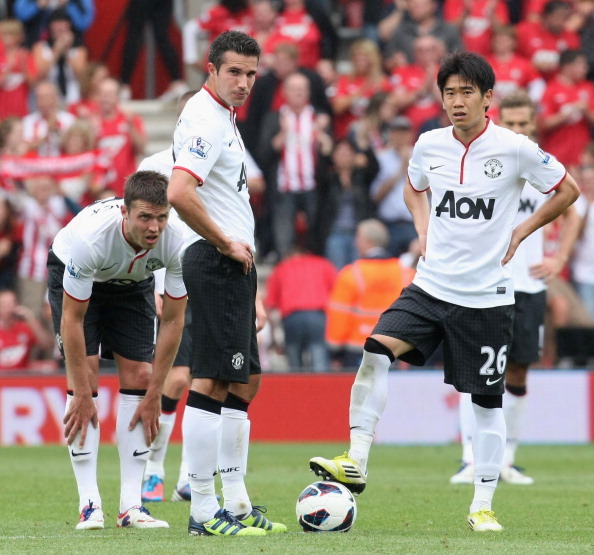
Shinji Kagawa started in the No.10 position for Manchester United in their 3-2 win at Southampton. In the opening minutes, United kept possession and pinned Southampton inside their own box with quick passes. However, after weathering this initial storm, Southampton came into the game and outplayed United for the majority of the first half. Ricky Lambert headed them into the lead, rising easily over Rafael and leaving Anders Lindegaard with no chance. If not for an untimely slip from fullback Nathaniel Clyne, allowing Robin van Persie to equalize, Southampton could’ve gone into the break with the lead. Southampton continued to play well in the second half and looked to have collected all three points going into the last five minutes with a 2-1 lead. However, van Persie scored twice to snatch the win for United and steal a first league win for Southampton.
Kagawa struggled in this game and was substituted for Nani in the 61st minute. In the Fulham match, Kagawa was brushed aside and lost possession several times against the massive Moussa Dembele. The physical side of the Premier League is something that he will, like all newcomers, take time to adapt to. While it’s not every week that he will face a midfield power/dynamo combo like Dembele, every team throws around its weight in the middle of the park, as Southampton showed. Morgan Schneiderlin and young James Ward-Prowse were outstanding and powered through a relatively delicate United midfield. It is no wonder that all of United’s goals were set up on the wing. There will be games like this for Kagawa as he gets used to the burly side to Premier League football. Tadanari Lee was an unused substitute, while Maya Yoshida was unavailable.
Stuttgart is stuck on 0 points in the Bundesliga after they were obliterated 6-1 by Bayern, a match that both Shinji Okazaki and Gotoku Sakai started. Okazaki was caught in possession by Luis Gustavo Dias for Bayern’s second goal. Gustavo played the ball to Toni Kroos who lashed in an unstoppable shot past Sven Ulreich.
Sakai was also caught in possession, for Bayern’s fourth goal. To his credit, after he was dispossessed by Kroos, Sakai raced across the pitch to heroically block Thomas Muller’s shot. However, he could only watch in despair as the ball rolled to Mario Mandzukic who tapped in.
Okazaki was subbed off in the 69th while Sakai played the entire 90 minutes. Not a great day for either of them, but it was Bayern and it is still early in the season.
Hiroshi Kiyotake started and played the entire match as FC Nurnberg drew 1-1 at home to Dortmund. Kiyotake set up Tomas Peckhart for Nurnberg’s goal with a corner. Nurnberg weren’t without their chances and did not hesitate to attack against the reigning champions.
Schalke beat Augsburg 3-1 at home, and Atsuto Uchida started and played the entire match at rightback.
Eintracht Frankfurt dealt Hoffenheim a heavy 4-0 home defeat. Takashi Inui started for Eintracht and was credited an assist for the first goal. He set up Alex Meier and the shot found its way into net, though only after a massive deflection off of Marvin Compper. Takashi Usami came on to play the second half for Hoffenheim.
Vitesse beat Feyenoord 1-0 at home to continue their excellent start to the Eredivise season. Mike Havenaar came on in the 81st minute and set up Wilfried Bony’s stoppage time winner with a shot/cross that Bony elegantly flicked into goal. Vitesse are now in second place with 1o points going into the international break.
Wigan Athletic drew 2-2 at home to Stoke. Ryo Miyaichi came on for Franco Di Santo for the last 10 minutes.
Keisuke Honda played the entire match as CSKA beat Krasnodar 1-0 away.
Yuto Nagatomo started and played the entire match as Inter were overrun by the attacking waves of Zdenek Zeman’s Roma, 3-1 at home.
Yuki Otsu has joined VVV Venlo on-loan from Monchengladbach. He will link up with Robert Cullen who was an unused substitute in their 1-0 loss at Twente.

Thursday, April 26, 2012

Japanese Players in Europe


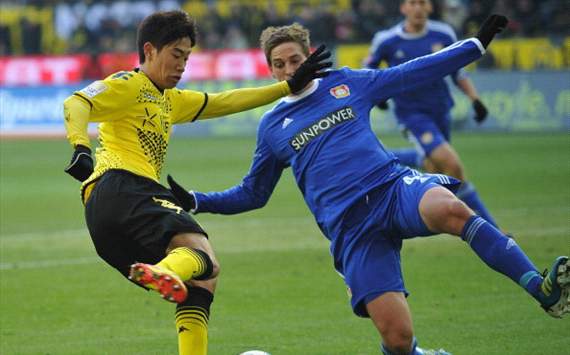
Borussia Dortmund clinched the Bundesliga title this weekend with a 2-0 home win over Borussia Monchengladbach. Shinji Kagawa scored the second goal, with a neat finish around Marc-Andre ter Stegen. His goal set off rapturous celebrations around the Westfalenstadion, with Jurgen Klopp running all the way from the technical area to be the first person to greet him. It was a fantastic scene, and it was good to see a great team finally break Bayern’s biennial tradition of being champions. Kagawa now has thirteen league goals, and should be a contender for Bundesliga Player of the Year. Highlights.
Stuttgart drew 1-1 away at Koln. Gotoku Sakai played the entire match, and Shinji Okazaki came on in the 69th minute for Martin Harnik. They remain in fifth place, six points off of Gladbach and Champions League qualification.
Vitesse drew 1-1 away at Heerenveen. Michihiro Yasuda played the entire match, and Mike Havenaar came on and scored a pretty equalizer. It was Mike’s fifth goal of the season since moving to the Eredivisie over the winter break. Vitesse remain in seventh and in a Europa League playoff spot. Video.
Inter could only muster a goalless draw away at Fiorentina on Sunday. Nagatomo came on in the second half for Javier Zanetti. Things got better on Wednesday, as they beat Udinese 3-1 away. Nagatomo played the entire match. The result brought Inter level on points with Udinese.
Takashi Usami played the entire match for Bayern Munich in a 2-1 win over Werder Bremen. It was nice to see Usami playing, but overall it’s been a shame to watch him on the bench. Maybe he’ll continue to get playing time in the Bundesliga and will earn a spot among the Champions League final substitutes.

Friday, March 16, 2012

Updates!

Sorry for the lull, finals were once again in the way. Here are some updates to make up for it.
Japan has qualified for the London Olympics. The U-23′s defeated Bahrain 2-0 to book their tickets to the summer tournament. Second-half goals from Takahiro Ogihara and Hiroshi Kiyotake sealed the win.

The senior side has been put in Group B for the fourth round of World Cup Qualification. Japan will play AustraliaIraq, Jordan, and Oman over the course of the next year. Australia will probably be the toughest opponents, but Iraq is coached by Zico who knows Japanese football very well.
Finally, here’s a video of Mike Havenaar’s time so far at Vitesse Arnhem. Mike has been scoring regularly since joining the team during the January transfer window–this video has all the goals and some training session footage. Enjoy!

Sunday, February 19, 2012

Japanese Players in Europe


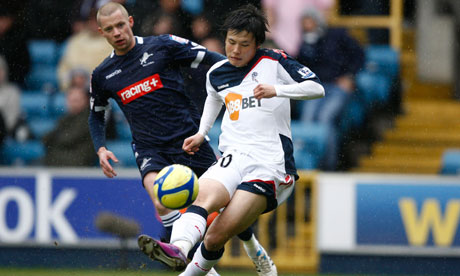
Despite Shinji Kagawa’s injury, this was a very good weekend for Japanese footballers in Europe. The star was Ryo Miyaichi who scored his first goal in English football in a 2-0 Bolton win away at Millwall. Ryo ran past the Millwall defense and curled into the back of the net to give Bolton a 1-0 lead in three minutes in. After the match, he said that the finish was inspired by Thierry Henry and Robin van Persie: “When I was at Arsenal, I saw many times Henry score same way during training. [Robin] Van Persie also did it, from the right flank. They showed very good example for me. That’s why I could score today.” (Guardian) This was Ryo’s second appearance for Bolton, and they have both been good performances.

Mike Havenaar scored his second Eredivisie in a 4-1 defeat to Twente. Mike came on as a substitute in the 73rd minute, and scored in the 88th, with the score at 4-0. The loss leaves Vitesse in 7th place, but on the bright side Mike continues to play well! Michihiro Yasuda also played in this game

Shinji Okazaki scored an outrageous overhead kick in Stuttgart’s 4-2 defeat at the hands of Hannover. Stuttgart slipped to ninth with the loss. Still, a great goal, and the proper celebration given the score.

Maya Yoshida scored as Venlo smacked fellow strugglers De Graafschap 4-1. Robert Cullen came on for the second half. The win brings Venlo to within two points of safety.

Tadanari Lee scored his first goal for Southampton in a 4-0 win over Derby County. Lee came on in the second half and scored in the 75th. It was a great goal.

Nagatomo played well again, however Inter lost again 3-0 to Bologna. It was Inter’s third straight loss, and third straight game in which they failed to score. They are now in seventh place.

Finally, Kagawa will miss Dortmund’s next few games as he injured his ankle during midweek training. He had been in great form, which makes the injury all the more disappointing.

Tuesday, February 14, 2012

Japanese Players in Europe


Borussia Dortmund maintained its two-point lead atop the Bundesliga with a 1-0 victory over Bayer Leverkusen. The match was settled by a brilliant individual goal by Shinji Kagawa. After a poor start to the season, he has really hit form and, with Robert Lewandowski, has been Dortmund’s best player in the absence of Mario Gotze. He has now scored four times in 2012, leading Dortmund to top of the table and an undefeated record on the year.

Ryo Miyaichi made his English debut, playing the entire second half of Bolton’s 2-1 home defeat to Wigan. He was brilliant throughout and almost salvaged a point for the Wanderers, forcing a great save from Ali Al-Habsi. Manager Owen Coyle singled Ryo out for praise in his post-match interview.

Mike Havenaar played the entire match, as Vitesse lost 3-1 away to Feyenoord. Red-hot Man City loanee John Guidetti had yet another hattrick for Feyenoord who moved up to fourth with the win. Michihiro Yasuda was an unused substitute.

Shinji Okazaki scored once as Stuttgart smacked Hertha Berlin 5-0. The win lifts Stuttgart to 9th in the table. Makoto Hasebe and Wolfsburg are one spot ahead in the standings, winning 3-2 over Freiburg. Captain Hasebe played the entire second half. Meanwhile, Takashi Usami was an unused substitute as Bayern beat relegation-bound Kaiserslautern 2-0.

Both Maya Yoshida and Robert Cullen played as VVV beat Groningen 2-0, to climb further from automatic relegation. Yoshida played the entire match, while Cullen came on as a late substitute. Meanwhile, Yoshiaki Takagi maintained his place in the first team as Utrecht drew 1-1 Ado Den Haag.

Sorry for the long absence readers, I will be posting more regularly now.

Friday, January 27, 2012

Mike Havenaar Scores His First Eredivisie Goal


Mike Havenaar made the switch from J. League to Eredivise this winter, moving to Vitesse Arnhem. Last week he came off the bench to make his debut. Today, he came off the bench once again, and scored his first Eredivise goal, against giants PSV no less. Vitesse ended up losing 3-1.

Mike came off the bench on the 81st minute and took just three minutes to get Vitesse a goal. From J.2 to scoring a goal against a perennial Champions League team in a year, it has been a rapid rise for Mike. Hopefully he will keep banging them in, for club and country.

Here’s the goal.

And here’s his postmatch interview (it’s in Dutch).

Wednesday, December 28, 2011

Nominees for Player of the Year Awards


Here are the nominees for the inaugural end-of-year Japan Footblog Player of the Year Awards. Please let me know if there are any glaring misses or players that are more deserving.

Japanese Player in Europe: This award is for the player who was the most important for his club team. Bonus points if they were really good for the national team.

  • Shinji Kagawa: After a first half of the 2010-11 season in which he took the Bundesliga by storm, Kagawa broke his foot in the Asian Cup and didn’t play for Dortmund again until this fall. His second season hasn’t been as magical, marked by some poor performances early in both the Bundesliga and the Champions League. However he was picked it up and has displayed the skill that made him the subject of many transfer rumors over the summer. He has six goals overall this season. Also, he was incredible for the national team–the single-handed rescue against Qatar in the Asian Cup and the dismantling of South Korea in the 3-0 victory over the summer are two performances that quickly come to mind.
  • Keisuke Honda: Like Kagawa, Honda has struggled with injuries this year. Nonetheless he still managed to score nine goals, leading CSKA Moscow to second place and a place in the RPL’s ridiculous ‘Championship Group’. He was also pretty good for the national team, winning (probably undeservedly) the MVP award for the Asian Cup.
  • Yuto Nagatomo: Again, injured for a bit, but when he played he was excellent. Now one of the first names on the team sheet for Inter, Nagatomo has become one of the most exciting players in Serie A. He has scored three league goals and has shredded countless defenses. Recently, he has been vital to Inter’s resurgence as they have managed to overcome a terrible start. Finally, he was at the center of two of the iconic moments in Japanese football in 2o11: the cross that set up Tadanari Lee’s Asian Cup winning goal, and waving a Japanese flag after Inter beat Bayern in the Champions League in support of the earthquake and tsunami victims in March.
  • Shinji Okazaki: He had a good season for Stuttgart last season, and has been decent this season so far as has his team. Didn’t stand out on the club level like the other three, but he was incredible for the national team. He scored three times in the Asian Cup and has scored five goals in World Cup qualifying so far.

Japanese Player in J. League: This blog has focused on players in Europe but I promise that next season the J. League will be covered. The primary purpose of this award is to identify some of the players that could potentially make the jump to Europe, and to show some love to the J. League greats.

  • Mike Havenaar: In his first season with Kofu, Havenaar led the club to promotion with 2o goals. In his second season, Havenaar took no time to acclimatize to J. League 1, scoring 17 goals (40 percent of Kofu’s total). He was unable to prevent Kofu from being relegated but his performances were so outstanding that he was called up by Zaccheroni to the national team. Naturally, he scored twice in three matches. Starting in the new year, Havenaar will be playing along Michihiro Yasuda at Vitesse.
  • Junya Tanaka: Kashiwa Reysol had an incredible season. After winning promotion, they wasted no time and promptly won the J. League title in their first attempt. A lot of the plaudits were deservedly given to J. League player of the year Leandro, but equally as important to the team’s amazing success was Tanaka, who scored 13 times for the champions. He was also called up for the national team for the first time.
  • Marcus Tulio Tanaka: The best defender in the J. League. He was the anchor for Nagoya as they posted the league’s second-best defensive record. He also chipped in with six goals and wasn’t booked a single time. Yes, not a single yellow card all season. Wow.
  • Yasuhito Endo: Maybe the best J. League player of all time, and he was at it again this season. He was the heartbeat of a free-scoring Gamba side that found the net eleven more times than any other team in the league.
Young Player of the Year: We should get used to hearing these names, both on the club and national team level.
  • Ryo Miyaichi: He lit up the Eredivisie with Feyenoord in the first half of the year, then shined for Arsenal in Carling Cup and reserve matches. Recently he’s been hurt, but everyone is eager for Ryo to return in 2012.
  • Takashi Usami: On loan at Bayern Munich from Gamba, Usami has looked ridiculously out of place with the reserves, and will likely feature more prominently in the first team in 2012. So far, he has scored six times in 14 reserve appearances and has even scored for the senior team in a cup win.
  • Hiroshi Ibusuki: Now playing for Sevilla, Ibusuki has scored eleven goals in 18 matches for the reserves and has recently been on the bench for some Liga matches. Don’t be surprised to see him in some cup matches in the new year.
  • Hiroshi Kiyotake: Osaka’s ‘second team’ had a disappointing 2011, however Kiyotake continued to impress. He scored seven league goals from the midfield, adding four more in the Champions League. He also made his debut for the national team, playing in three matches.

Tuesday, October 11, 2011

Japan 8-0 Tajikistan


Japan were outstanding. Let’s get that out of the way. Tajikistan weren’t great and they did not press the ball like they should have, but Japan were still very good. 8-0 is the result of excellent play no matter the opposition.

Mike Havenaar opened the scoring in the 12th minute with his first international goal. The goal was good, but the celebration was even better. The look of utter jubilation that he had after scoring for his country for the first time was heartwarming and reminded me of why I watch football in the first place.

Seven minutes later Shinji Okazaki scored. Intense pressure by Okazaki led to Tajikistan conceding possession, and then slick passing in the box by Kengo Nakamura and Shinji Kagawa, with a nice dummy from Havenaar left Okazaki with a opportunity to finish. This was the goal of the match.

Then sixteen minutes later Yuichi Komano scored. Again tidy passing in the box between Komano and Havenaar’s chest gave Nakamura an opportunity that was saved, only for the ball to be laced into the back of the net by Komano from outside the box. It was also his first goal for Japan. Everybody was getting on the scoresheet. Except for talisman Shinji Kagawa…

…who scored six minutes later. After some short passes with Nagatomo, Kagawa made a clever run and was picked out by Nakamura (again) and he scored with a first-time dink with the outside of his right foot. Another excellent goal. That was it for the first half.

If Tajikistan had planned damage limitation in the second half, they had to scrap that plan two minutes in when Havenaar got his second. His placed header off a Komano cross left the Tajik keeper with no chance. Then Kengo Nakamura scored in the 56th minute. It was a deserved goal for the midfielder who had created close to ten chances till then. Then Kagawa scored in the 68th. It looked like a cross that flew directly in, but in the post-match interview he said that it was a shot. Then Okazaki scored in the 73rd. A regular header at the back post. Then that was that.

This match could’ve been a trap. After a draw away in the most difficult tie of this round of qualifying, heavily-favored Japan returns home fully expecting three points from Tajikistan, who are only still around because another team was disqualified. Japan struggles to score in the first half against a dogged Tajik defense, before conceding a counterattack goal midway through the second half. Tajikistan holds off for the shock 1-0 win. Thankfully, this did not happen. Zaccheroni definitely had his team ready after a light friendly with Vietnam last week.

Tajikistan is not a bad team. They only lost to North Korea and Uzbekistan 1-0 each in their first group matches. Granted they were only still in qualification because Syria was thrown out, they are no San Marino. Japan was just very good.

Japan had 45 shots while Tajikistan had zero. It seemed as if Japan always had the ball, and when Tajikistan did have it, they couldn’t string two passes together. Kawashima didn’t touch the ball until towards the end of the first half. It was one of those games where you wanted to see everyone get on the score sheet. And you wanted the stars to get hattricks. Instead we had to settle for three braces.

Some points: The match was in Osaka, Kagawa’s hometown. It was great to see the fans cheer on their native son who rewarded their support with a fine display. It was also good to see Kagawa with some clinical finishes, something he has not been doing so far this season in Germany.

The Tajik players did not have names on the back of their shirts–they had ‘Tajikistan’. Whether this was to promote unity or just because they didn’t have individual shirts ready is not clear. But it was funny to see.

This was Japan’s last home game of the year. The next match is away at Tajikistan on November 11 followed by another away match at North Korea four days later. Four points from the two matches would see Japan progress to the fourth round.

Highlights.

Friday, September 2, 2011

Japan 1-0 DPRK


Well, that was close. Japan scraped enough together at the end to beat North Korea at home and begin its World Cup qualification with three points. VVV Venlo defender Maya Yoshida won it in stoppage time with a powerful header. It was far from the outstanding performance in the August win over South Korea, but in the end Japan got a valuable win to begin its journey to get to Brazil.

The match was basically one of those Carling Cup affairs where Liverpool or Chelsea play Havant & Waterlooville (no disrespect) and spend the entire 90 minutes passing the ball around but in the end lack the cutting edge to put the ball in the net and prevent an arduous replay. Japan kept the ball well on the wings and passed it around their opponents with ease, but lacked the creativity to get behind the back four. Most of the attacks ended with Atsuto Uchida putting in an underwhelming ball.

Zaccheroni again showed his managing skills with two astute second half changes in an effort to prevent the match from ending in a predictable and disappointing draw. He took off Yosuke Kashiwagi who had a largely pedestrian evening filling in for the injured Keisuke Honda, and threw on the Cerezo Osaka youngster Hiroshi Kiyotake. Then in the 70th, Zacc gave a highly-anticipated debut for Mike Havenaar. The presence of the two subs galvanized the team to pursue a crucial goal, and for the final twenty minute Japan laid siege on the North Korean box, banging a couple shots off the crossbar and forcing keeper Myong-Guk Ri to make several superb saves. They got the goal three minutes into stoppage time, as Yoshida put in Kiyotake’s ball.

Improve: Kagawa, Okazaki, and Kashiwagi lacked ideas in the final third and couldn’t get behind the North Korean defense. Obviously the absence of Honda and Nagatomo took away some quality attacking members, but the overwhelming reliance on balls from the wings should be addressed.

Good: Havenaar brings an Andy Carroll type to the team– excellent in the air but with good technical abilities. He can be a good plan b if Japan needs to get the ball up top quickly, and his skill ensures he won’t disrupt the team’s short passing. It was also good to see some young J. League players in the squad.

Man of the Match: Makoto Hasebe put in an excellent shift as captain. He showed good attacking prowess in addition to his usual defensive contributions.

Next up, an away match at Uzbekistan, the growing continental force. Hopefully Japan will show its cutting edge.

Saturday, August 27, 2011

The Importance of Mike Havenaar


Note: This is an updated version of the original post from 28 August, 2011

Mike Havenaar is a Japanese footballer. Despite the name, the towering physical presence, and the European appearance, Mike Havenaar is 100% Japanese. Soon he could be one of the biggest stars on the Japanese national team.

Havenaar was born to Dutch parents in Hiroshima in 1987, where his father was playing football professionally. He began his career in the youth system for Consadole Sapporo, his father’s team, before moving to Yokohama F. Marinos as a teenager. After some loan spells, Mike (that’s what J. League fans call him) moved to J2 side Ventforet Kofu in 2010 and was an instant success. He scored 20 goals in his first season, earning the team promotion to J1. This past season, he proved that the jump to J1 was not a step too far, scoring 17 league goals and being named to the J League Best Eleven. He couldn’t save Kofu from immediate relegation, but was good enough to be noticed by several European teams, including Stuttgart and Wolfsburg. Ultimately, he moved to Vitesse Arnhem over this winter period, and has already scored a goal in three Eredivisie appearances.

This past year, he was also called up for the Japanese national team. So far, he has 5 caps, and has scored twice, both in an 8-0 trashing Japan dished out to Tajikistan in World Cup qualifying. Mike’s inclusion into the national team is significant. He is not the first player of foreign descent to play for Japan. The two most well known examples are Alessandro Santos and Marcus Tulio Tanaka, both of whom enjoyed exceptional success for the national team. However, both Santos and Tanaka are of Brazilian origin, and a long history of immigration between Japan and Brazil has led to a greater level of acceptance for Japanese-Brazilians than experienced by most other foreign groups. Mike, on the other hand, is European, and does not get this break. In most parts of Japan, it is not everyday that you see a white European who speaks perfect Japanese and considers himself completely Japanese, like Mike does. For this reason, Mike’s emergence onto the national team is a big deal, and could hold implications for Japanese culture and society that extend beyond the confines of football.

Despite being one of the largest economies in the world, into which thousands of people traveling to and from everyday, Japan remains a difficult country for foreigners to be accepted in. Outside of Tokyo, it is not uncommon for locals to stare at any foreign-looking person in surprise. Foreign businessmen and women are often denied entrance to restaurants because of their appearance. I am half-Japanese, and when I went to elementary school in Osaka, I was made fun of and bullied just because of my foreign appearance, despite my fully Japanese name and the fact that I spoke fluent Japanese. This behavior does not reflect any feelings of race-based enmity, but rather a lack of exposure to foreign presence. Japanese people do not dislike foreigners—they are simply not used to them in their society. For this reason, many see a foreign presence as a threat—and act to protect their culture.

There is no better indicator of this feeling than the foreign labor policy of the government of Japan. Currently, Japan is experiencing the crisis of a declining population. If the current rate of decline continues, the population of the country will be cut in half to 60 million by 2050. Despite this, the Japanese government has absolutely no interest in loosening immigration regulations to allow a greater foreign influx. On top of that, Japan is experiencing a labor shortage, as an aging population retires and fewer youths are inclined to work. The government has so far responded with measures to increase the participation of women in the work force and with temporary contracts with Chinese, Vietnamese, and Filipino workers. These workers all have to go home in two years.

Despite the country’s rapid postwar growth and subsequent increased role in the global economy, Japan has never had a large foreign presence. This lack of exposure has left parts of the population still uncomfortable with the idea of foreigners in Japan. Mike has experienced this sentiment first hand in the J League, when he was the target of anti-European chants from some supporters. If Mike is successful for the national team, it could help dissipate some of this feeling and lead to the further acceptance of foreigners in society. Japan is a country that idolizes its sport stars; following the devastating ‘triple disaster of the Tohoku earthquake-tsunami-nuclear accident in March of last year, the entire country supported Nadeshiko Japan as they won the Women’s World Cup. The success of the women’s national team helped ease some of the pain felt from the greatest national tragedy since the war. Should Mike become a national team legend and a household name, he could help the country overcome a cultural attitude that has lingered long enough. In his first interview for Vitesse, Mike proclaims in Dutch, that although his parents are from the Netherlands he feels completely Japanese. Perhaps through success with the national team he can show that at 6-4 and white, with the name ‘Mike Havenaar’, he is 100% Japanese.

Here’s an interview of Mike speaking perfect Japanese. And here's a video of him in action.