Showing posts with label London Olympics. Show all posts

Wednesday, August 15, 2012

Olympic Review

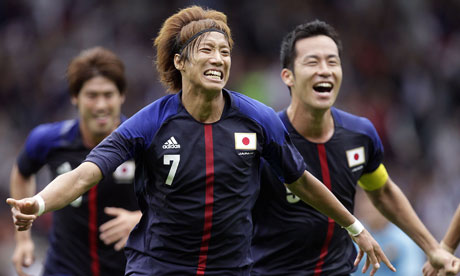
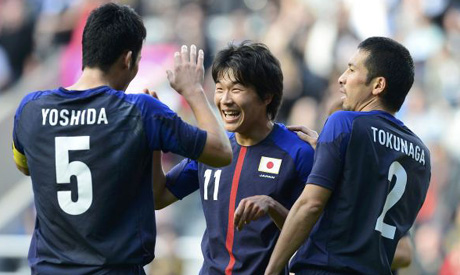
The Japanese men's Olympic football team performed well at London 2012.

The Japanese men finished in fourth place at the Olympics. This was a great finish, but one feels they underachieved at the end. After finishing first in their group and beating a dangerous Egypt side 3-0 in the quarterfinals, they seemed to flame out in the semifinals and the bronze medal match.
Japan 3-0 Egypt. Kensuke Nagai got things started in the 14th minute, using his increasingly impressive pace to get on the end of a great ball from Hiroshi Kiyotake. As the Egyptian keeper collided with his defender, Nagai slotted into an empty net. However, Nagai ran into defender Ahmed Hegazy on the play and was unable to continue after his goal. He was replaced by Manabu Saito, who dropped into the midfield. Otsu played a slightly forward role for the rest of the match. Japan’s cause was further aided in the 41st minute when defender Saad Samir was shown a straight red card for a last ditch foul of Saito. Egypt were excellent on the ball and were able to keep possession throughout, but with a man less opportunities to get on the ball were fewer. Japan made it 2-0 in the 78th minute, when Maya Yoshida headed in a free kick from Kiyotake. It was 3-0 in the 83rd when Otsu headed in a cross from Takahiro Ohgihara. Japan definitely benefited from the man advantage (two men towards the end when Egypt lost a man to injury and were out of substitutions) but played extremely well against a talented and dangerous team. Kiyotake was superb and controlled the match. Maya Yoshida was excellent as usual.
Mexico 3-1 Japan. Mexico played well and deservedly went through, but it was nonetheless disappointing to see, especially since Japan beat this same team five days before the Olympics. Otsu got things started and had me on my feet with a wonderful 20-yard volley in the 12th minute. Japan were playing well and looked to be in control. However, Mexico got back into the game and looked increasingly threatening. Gio Dos Santos in particular missed a golden chance to level the match. The pressure told in the 31st minute when Dos Santos’ corner was flicked on by Jorge Enriquez and nodded in by Marco Fabian. It was the first goal that Japan had conceded all tournament, and Gonda had no chance.  Mexico continued to play well into the second half, and Japan struggled to produce anything in midfield. Oribe Peralta made it 2-1 in the 65th minute with a well-placed shot that again left Gonda helpless. Ohgihara was dallying on the ball outside of the box and Peralta dispossessed him before launching his shot. Japan tried to press and find an equalizer but found it difficult to play out of the midfield against a Mexico side that liked to keep the ball wide. Fabian in particular caused Japan lots of problems. As Japan searched for an equalizer, Mexico scored a third on the counter. Javier Cortes took advantage of some poor defending and scored on a shot that Gonda should have definitely saved. Japan’s midfield picked the wrong day to have its worst match of the tournament, with Kiyotake and Higashi well below par.
South Korea 2-0 Japan. Outplayed and outmuscled in the consolation match against their Asian rivals. Korea were fired up for the match and pressured Japan from the start. Japan were able to start passing the ball well but were unsettled by some tough challenges from Korea. Park Chu-Young gave Korea the lead in the 38th minute after dancing his way around some terrible defending. The shot was a weak one and Gonda probably should have kept it out. It was 2-0 in the 57th minute when the excellent Koo Ja-Cheol was put through by Ji Dong-Won and shot under Gonda. Japan searched for a way back into the match, and thought they had one when Maya Yoshida put a superb header into goal. However it was correctly ruled out for a block on keeper Jung Sung-Ryong. Again, the midfield was below par and was unable to consistently threaten the Korean defense.
Watching the tournament, one thing that became clear to me was the huge gap between youth sides and the senior side. On pretty much every team in the tournament, the overage players stood out. Thiago Silva, Maynor Figueroa, Craig Bellamy, Nordin Amrabat all performed noticeably better than some of their younger teammates. This was the same with Maya Yoshida, who was comfortably the best player for Japan in the tournament. It shows how important experience at the highest level is for international football.
In addition to Yoshida, Kiyotake was superb throughout the tournament. Up until the semifinal, he controlled matches with his darting movement and varied passing. He set the tempo with short passes, but showed he was equally adept at longer ones, serving up assists with two such passes against Egypt. Hiroki Sakai was superb at rightback. He was excellent in defense and provided width and speed on attack. When he played, Gotoku Sakai was equally as good. I thought he probably should’ve started on the left. Yuki Otsu has the potential to be a great player, and should play more for Monchengladbach this season. He played well throughout the tournament and provided good movement in support of Nagai, who was also excellent bar some poor finishing against Spain. Ohgihara looked comfortable on the ball and provided excellent set piece delivery. Gonda has the potential to be a future No. 1.
It was a great tournament and I am really looking forward to watching these guys play in the future.
Congratulations to the women’s team who finished with a silver medal, losing 2-1 in the final to the US. The women outplayed the physically strong US team and could have gotten a better result had it not been for great saves by Hope Solo and some questionable calls by the referees. The result further cements Nadeshiko Japan as overall one of the best women’s teams, and surely the best in terms of playing beautiful football.

Wednesday, August 1, 2012

Japan 0-0 Honduras

Kazuya Yamamura battles with Luis Garrido of Honduas.

A 0-0 draw with Honduras was enough for the Japanese men to secure first place in Group D and a quarterfinal matchup with Egypt on Saturday. The result suited both teams, with Honduras finishing in second place and also progressing.
In the history of goalless draws, this will not go down as one of the more riveting ones. While both teams seemed somewhat interested in scoring, neither were able to get behind the defenses and create chances. The only moment when it looked like the deadlock might be broken was in the first half when Jerry Bengston got on the end of ball from midfield and got a shot through on goal, but Shuichi Gonda was able to get down sharply and then gobble up the rebound.
Honduras started the first half better, but Japan got better later on and were able to string some passes together. The second half was similar, with Honduras starting better and Japan gradually growing into it. By the end, most of the football was being played by Japan in and around the Honduras box.
Takashi Usami was one of the newcomers in the match and didn’t have much of a chance to shine. With neither team really interested in playing through the midfield, Usami’s contributions were mostly through moments of individual flair, which he had a couple, and set pieces. He seemed to hit his free kicks and corner kicks deep, and one set piece had the Honduran keeper Jose Mendoza struggling back to tip the ball over the bar.
The standout performer was Gotoku Sakai who played on the left after playing on the right against Spain and Morocco. He let absolutely nothing through and was excellent bringing the ball forward. He used his impressive speed to cut out passes and add width to attack when needed.
D.C. United youngster Andy Najar was the most dangerous player for Honduras. He showed some great speed and close control, and when he was substituted off in the 60th minute, the Honduran attack became noticeably less dangerous.
Shuichi Gonda made a couple excellent saves and was commanding in his box. He plucked out crosses pretty comfortably and had the confident look of an established senior level keeper. The defense as a unit still has yet to concede a goal in the tournament.
The midfield looked a lot better once Hiroshi Kiyotake came on in the 67th. Passes started to connect in the middle, giving more space to the wide players. Kensuke Nagai also improved the attack when he came on in the 81st.
Overall, a good result that achieves the goal of first place.

Monday, July 30, 2012

Japan 1-0 Morocco

Kensuke Nagai scored the winner in the 84th minute.
The Japanese men defeated Morocco 1-0 to book a place in the quarterfinals. Kensuke Nagai scored the only goal in the 84th minute of an entertaining match. The victory leaves Japan needing only a draw against Honduras to secure top spot in the group and likely avoid Brazil in the quarterfinals.
Morocco started the match very well, keeping the ball and moving it across midfield comfortably. Japan didn’t seem to be pressing with the same urgency as they had against Spain, and as a result Morocco was able to keep possession without much trouble. Former PSV man Nordin Amrabat had a great chance to open the scoring in the 18th minute but his shot was blocked by Gotoku Sakai. Japan got better as the half wore on and Moroccan keeper Mohamed Amsif had to produce a wonderful goal-line save to prevent Sakai from heading home the opening goal. Maya Yoshida had a free header just before half-time but couldn’t put his effort on target.
Morocco started the second half strong and were able to keep possession in much the same way they did early in the first half. However, again Japan improved as the half wore on. In the 62nd, Amsif had to produce another glorious save to prevent Japan from scoring. Hiroshi Kiyotake unleashed a great shot that Amsif managed to tap onto the crossbar. The ball then bounced off Amsif’s back straight into the air for an easy take. In the 70th, Amsif prevented Japan from scoring once again, this time pushing Yuki Otsu’s shot just left of the post. Japan had another chance in the 78th when Kensuke Nagai played in Hotaru Yamaguchi with a beautiful flick, but Yamaguchi blazed his first time shot over the bar.
The breakthrough finally came in the 84th when Kiyotake played a perfect ball over the defense that Nagai lobbed over the charging Amsif with his first touch. Amsif had rushed out thinking he would reach the ball first, but the speedy Nagai beat him to it and lobbed with the outside of his right. It was the type of magnificent finishing that Japan had lacked against Spain.
Morocco had their best chance of the match in stoppage time as the dangerous Zakaria Labyad was played through on goal. His effort was stopped by Gonda, and a rebound shot from Omar El Kaddouri was blocked by captain Yoshida.
Morocco were excellent and had no trouble keeping possession. All their players were comfortable on the ball and able to pass it with ease. Morocco’s passing was helped by Japan’s lack of pressing at times, but even when they were pressed they combined well, especially down the left where Labyad was lively throughout.
Unlike Spain, Morocco also had a great forward presence in the excellent Nordin Amrabat. He held the ball up expertly and linked well with the wide players. However, like Spain, Morocco did struggle to get behind the Japanese defense and create clear chances.Their two biggest opportunities came from a set piece and a long ball over the top. Labyad also had a couple shots from long range.
Japan was unable to keep the ball in midfield as well as they did against Spain. Otsu, Kiyotake, and Keigo Higashi did have great moments of combination, but most of the midfield threat came when they ran at the Moroccan defense. Otsu and Kiyotake were particularly good in this regard. No time yet for Takashi Usami who might have helped with the passing in the second half.
Nagai wasn’t pressing the defense as much as he did against Spain, but he still held up play very well and was able to reach passes with his speed. His finish was a thing of beauty.
Once again the defense was very good, with Yoshida excellent in the center. Gotoku Sakai was great on the right, but didn’t provide as much attacking verve as Hiroshi Sakai did against Spain. Gonda was excellent in goal as well. After two games, Japan and Mexico are the only teams that have not conceded a goal.
Another great win for Japan and one more point to clinch first place in the group.

Spain 0-1 Japan


Yuki Otsu scored the winner against Spain.

Unless you’ve been ignoring the Olympics completely, you’ve heard about Japan’s magnificent win over gold medal favorites Spain. Yuki Otsu scored the game’s only goal in the 34th minute off a corner. A few minutes later, Inigo Martinez was sent off for fouling Kensuke Nagai on a breakaway, but Spain was still able to keep much of possession despite being a man down. Japan had a number of chances to extend their lead in the second half and put the game to bed, but their poor finishing didn’t come back to haunt them as Spain never really threatened.
Despite poor finishing in the second half, this was a great win for Japan. Going into the match, Spain was a favorite for the gold. They had World Cup and Euro winners Juan Mata and Javi Martinez. They had Jordi Alba, one of this Euro’s best players. They had the electric Bilbao midfielders Ander Herrera and Iker Muniain. They had one of the world’s best shot-stoppers in David De Gea. On paper, this team could challenge for senior international titles. And Japan beat them, pretty comfortably. Besides an early long range shot from Juan Mata, I don’t remember Shuichi Gonda really being troubled. Only twice (Adrian and Alba) did Spain get behind the Japanese defensive line. On the other hand, I can remember Japan having four great opportunities to extend their lead. This wasn’t a smash-and-grab against one of the most talented and accomplished teams in the tournament. It was a deserved victory that could’ve been more.
The sending off benefited Japan, but it wasn’t decisive. In the second half, they were able to keep the ball longer and expose Spain’s lack of defensive cover. Spain also had one less player to press with and allowed Japan to keep the ball for longer, but they were able to keep the ball as well as they had been with eleven men. Aside from some of the chances that Japan created and missed anyway, the man advantage wasn’t that influential in the game.
Spain’s biggest problem was lack of an attacking outlet. They needed someone to remain central to finish off crosses and passes, but all of their attacking players were more interested in staying wide. The senior side suffered from a similar problem at the Euros, but they were able to get behind defenses much more frequently than the Olympic side today. Considering that largely the same team had no problems scoring at last year’s European Under-21 Championships, Spain’s lack of attacking options was surprising.
While Spain were able to keep much of the possession, Japan won the midfield battle. Otsu, Hiroshi Kiyotake, and Keigo Higashi were able to keep the ball and combine brilliantly with lone striker Nagai. Otsu in particular caused havoc on the right side of the Spanish defense throughout the first half.
Captain Maya Yoshida was immense in the center of defense, breaking up attacks before Spain could camp players outside the box. Yoshida also elegantly carried the ball into midfield on a number of occasions. Hiroki Sakai was also terrific on the right, keeping Jordi Alba quiet and providing speed on the counter. After he was forced off because of injury, Gotoku Sakai was equally impressive as his replacement.
Despite missing some chances, Kensuke Nagai was excellent as the lone striker. He held up play, opened up space with his speed, and, most importantly, pressed the Spanish defenders and caused several giveaways.
On the Spanish side, De Gea was excellent. He saved Nagai’s shot on a breakaway, and displayed his world class shot-stopping skills early in the second half against Higashi.
This was a hugely important win, not only because it was against Spain, but also because the group runners-up face Brazil, a matchup you want to save for later.
A great win and a great start to the London Olympics.

Olympics So Far: Japan Qualifies For The Quarterfinals


Kensuke Nagai scored the winner against Morocco.

Here’s a quick update on the Japanese Men’s Football team at the London Olympics. After 1-0 victories over Spain and Morocco, Japan has qualified for the knockout stages. I will post full reports on both matches later today.
The victory over Spain was stunning, and Japan probably should’ve won by more. Spain controlled possession but were unable to create any clear chances. Yuki Otsu’s first-half goal was enough for the three points.
Morocco was a tough opponent and were comfortable in possession. They started both halves strongly and had a good chance through the excellent Nordin Amrabat. But as time passed, Japan became better and started to dictate play. Kensuke Nagai grabbed a late winner to send Japan into the knockout rounds. Surprisingly, Spain lost again 1-0 to Honduras and were eliminated.
Japan will need at least a point against Honduras to clinch first place. They will be especially eager to do so as second place secures a likely quarterfinal match with Brazil.
On the women’s side, Japan are second in their group after a win over Canada and a goalless draw with Sweden. After an opening 2-1 win over Canada, Japan were unable to score against a Sweden side they defeated in the semifinal of last year’s Women’s World Cup. Japan will play South Africa tomorrow in their final group match.

Monday, July 2, 2012

Olympic Football Roster Announced


Kenyu Sugimoto was a surprise inclusion.

The Japan Olympic football squad was announced today, and there were some surprise inclusions/exclusions. Here’s the squad:
Keeper: Shuichi Gonda, Shunsuke Ando
Def: Yuhei Tokunaga (overage), Maya Yoshida (overage), Daisuke Suzuki, Hiroki Sakai, Gotoku Sakai
Mid: Hiroshi Kiyotake, Taisuke Muramatsu, Keigo Higashi, Hotaru Yamaguchi, Takahiro Ogihara, Takashi Usami
Fwd: Kensuke Nagai, Yuki Otsu, Manabu Saito, Kenyu Sugimoto
Injury standby: Akihiro Hayashi (keeper-overage), Kazuki Oiwa (def), Takuji Yonemoto (mid), Ryohei Yamazaki (fwd)
The notable omission has to be Ryo Miyaichi. The most likely explanation is that Arsenal were not going to release him for the Olympics. However, the fact that they posted a note on their website about his inclusion in the preliminary squad, and the rumors swirling about his imminent loan move to Southampton, indicate that a) they were at least entertaining the idea of letting him go, and b) since he is moving on loan, his participation in the Olympics didn’t matter to them at all. So, if Arsenal were in fact okay with him being in the squad, then this is a ridiculous omission. Firstly, he played regularly for Bolton last season, in the most competitive league in the world. While he didn’t start every match, he came off the bench in the ones he didn’t, and at least got playing time in most of Bolton’s matches. This is more than some of the players chosen above him can say, playing in the J. League. Secondly, he is one of the most talented players that Japan have. The Olympics are the time to test out your talents, so take your most talented players.
Another omission is Yoshiaki Takagi who should’ve been at least a reserve. He started playing regularly for Utrecht at the end of last season, which should be enough to warrant a spot on the Olympic team. Yuya Osako, Mizuki Hamada, and Hiroshi Ibusuki were also omitted. Osako has been playing well for a an underachieving Kashima Antlers side this season. Hamada is an exciting central defender, but the JFA opted for overage players in that position. Ibusuki should’ve also been at least a reserve–he could’ve provided a plan b in the Andy Carroll mold.
The biggest surprise inclusion is Kenyu Sugimoto, who has four goals this season for Tokyo Verdy…in J.2. At 6 foot 2, he does provide that plan b, but clearly Ibusuki, with 20 goals in the Spanish third division, should get in ahead of him.
I will post about the potential starting xi in the future, but for now, what do you think?

Monday, June 25, 2012

The Summer So Far


Sorry for the extended absence–I just finished school and graduated. There was a lot to tie up at the end and things got quite busy, but graduation was one of the proudest days of my life. Congratulations to the Dartmouth Class of 2012!
While I’ve been away, there has been a lot going on in the world of Japanese football. For one, the next round of World Cup qualification began. Japan has got off to a flying start, and the match with Australia was one of the more electric qualifying matches for any tournament that I’ve seen. Shinji Kagawa has moved to Manchester United. As expected, the best Japanese player over the past two seasons has completed his dream move to England. Takashi Usami has moved to Hoffenheim. After a season of limited opportunities at Bayern, Usami moved to a different Bundesliga team where his playing time will most likely increase dramatically. Finally, the preliminary Japanese Olympic football team has been announced. I’ll examine all these things in the coming days as I get back to posting regularly.
Japan has gotten off to a great start in the fourth round of World Cup qualification. After three matches played in Group B, Japan is in first place with 7 points and a +9 goal difference. They started things off with a 3-0 home win over Oman, and then a 6-0 home win over Jordan. Honda scored a hat trick in the second game. In their third match, they earned a 1-1 draw away to Australia, in what was likely their most difficult fixture of the round. With two sendings off and an electric crowd of over 40,000, the match was a great spectacle. Next up for Japan is a home match with Iraq on 11 September.
Shinji Kagawa moves to Manchester United. Kagawa signed a four-year deal on Friday, 22 June. He had previously said that the Premier League was his dream destination, and after he rejected renewed terms from Dortmund, it was widely expected that his dream would be realized. When Alex Ferguson was on hand to watch Kagawa play an instrumental role in Dortmund’s 5-2 mauling of Bayern Munich in the DFB Pokal Final, a move to United seemed a certainty. After he signed, there was speculation as to whether he would wear the famous No. 7 shirt, with previous holder Michael Owen having been released. However, Kagawa said that he could not yet wear the shirt as he had not yet accomplished anything with the club, and would instead chose a number with “personal meaning.” I will post on where Kagawa will likely play for United and the implication his success could have for the national team in the coming days. But for now, congratulations to a great player on a great move! Personally, I can’t think of a team where he would be better suited to succeed.
Takashi Usami moves to TSG Hoffenheim. Usami found first team opportunities few and far between at Bayern last season. With Ribery and Robben playing the same position as him, it was always going to be difficult for Usami to break into the first team. He was a standout for the reserve team, however, and was regularly rewarded for his good play with a place on the first team bench. The move to Hoffenheim is perfect, and he should get consistent first team playing time.He’s still only 20 years old, and a good debut season could be the first step in a successful career in Europe.
The preliminary squad for Japan’s Olympic men’s football team has been announced. The 35-man roster includes Ryo Miyaichi, Hiroki Sakai (recently signed with Hannover 96), Gotoku Sakai, Hiroshi Kiyotake, and Usami. The three overage players are Yuhei Tokunaga (def, FC Tokyo), Maya Yoshida, and Akihiro Hayashi (gk, Shimizu S-Pulse). Kagawa and Honda were both left out after long club seasons. The squad will be trimmed to 18 + 4 reserve players by 11 July.
Look forward to regular posting now that I have graduated.

Friday, March 16, 2012

Updates!

Sorry for the lull, finals were once again in the way. Here are some updates to make up for it.
Japan has qualified for the London Olympics. The U-23′s defeated Bahrain 2-0 to book their tickets to the summer tournament. Second-half goals from Takahiro Ogihara and Hiroshi Kiyotake sealed the win.

The senior side has been put in Group B for the fourth round of World Cup Qualification. Japan will play AustraliaIraq, Jordan, and Oman over the course of the next year. Australia will probably be the toughest opponents, but Iraq is coached by Zico who knows Japanese football very well.
Finally, here’s a video of Mike Havenaar’s time so far at Vitesse Arnhem. Mike has been scoring regularly since joining the team during the January transfer window–this video has all the goals and some training session footage. Enjoy!